Is Your School Ready for AI? 3 Ways Interactive Panels Will Evolve by 2027
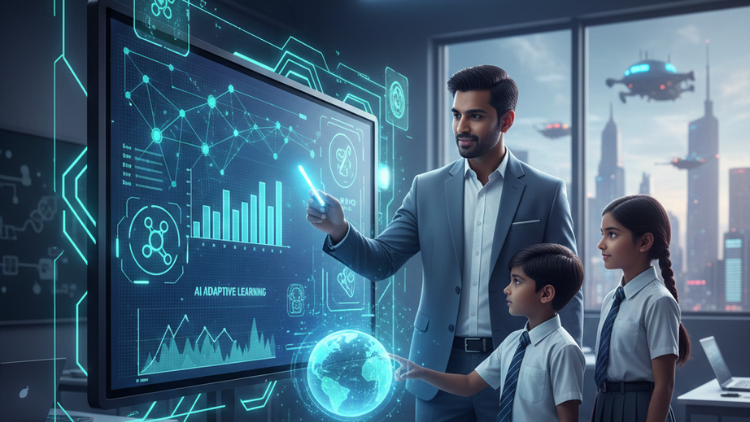
Why AI Readiness Matters for Indian Schools

1. Interactive Panels Will Become Intelligent Teaching Assistants

How This Evolution Will Look
For example:
- The panel will simplify explanations if students struggle.
- The panel will suggest advanced examples if students grasp concepts quickly.
- The panel will summarize key points at the end of the class automatically.
- This shift will redefine AI interactive panels in education as collaborative tools rather than display devices.
Impact on Teachers and Schools
2. Learning Will Become Personalized, Not One-Size-Fits-All

How AI Will Personalize Learning
For example:
- Visual learners will receive diagrams and videos.
- Text-focused learners will receive structured notes.
- Students needing extra support will receive step-by-step explanations.
Benefits for Indian Education Systems
3. Interactive Panels Will Integrate with the Entire School Ecosystem

What This Integration Will Look Like
During a single class, panels will:
- Record attendance automatically
- Capture key teaching moments
- Save annotated notes for students
- Share homework instantly
- Generate learning reports for teachers and school leaders
Why This Matters for School Leaders

Are Indian Schools Ready for This Shift?
To prepare for this future, schools should:
- Train teachers to work confidently with AI tools
- Choose scalable and upgradable panel solutions
- Focus on student outcomes, not just features
- Align technology use with NEP 2020 goals
What School Decision-Makers Should Look for Today
Next generation interactive flat panels should offer:
- AI-ready operating systems
- Secure data handling
- Teacher-friendly interface
- Local curriculum compatibility
- Long-term software support
Preparing Students for an AI-Driven World

Conclusion
By 2027, interactive panels will no longer act as digital blackboards. They will act as intelligent classroom partners. They will support teachers, personalize learning, and connect classrooms to larger school systems.
Indian schools that prepare now will lead this transformation with confidence. They will empower teachers, engage students, and meet the expectations of modern education.
The question is no longer whether AI will enter classrooms. The real question is whether your school will lead the change or follow it later.
The future is intelligent. The future is connected. And the future of classrooms begins today.
For More Information, Call or WhatsApp on: 89270-89270.
Frequently Asked Questions (FAQs)
A school can check its AI readiness by reviewing its existing digital infrastructure, teacher preparedness, and long-term technology vision. Schools should assess whether teachers feel confident using digital tools, whether classrooms have reliable internet, and whether current interactive panels support software upgrades. Schools should also evaluate if their teaching methods encourage student interaction rather than one-way instruction. Investing in AI interactive panels in education requires planning, training, and mindset change. Schools that focus on learning outcomes instead of just hardware usually adapt faster to AI powered smart classroom technology.
No, AI interactive panels will not replace teachers. Instead, they will support teachers by reducing repetitive tasks like lesson preparation, content searching, and manual assessments. AI powered smart classroom technology works as a teaching assistant, not a substitute. Teachers remain responsible for guiding discussions, motivating students, and building emotional connections. The future of interactive panels in schools focuses on empowering teachers, not removing them. Schools that use next generation interactive flat panels correctly will actually strengthen the teacher’s role rather than weaken it.
AI interactive panels in education improve learning outcomes by making lessons more engaging, personalized, and interactive. These panels analyze student responses and participation levels to adjust content delivery in real time. Students receive explanations that match their learning pace, which helps reduce confusion and learning gaps. AI powered smart classroom technology also encourages active participation through quizzes, discussions, and visual learning tools. Over time, students develop better understanding, stronger problem-solving skills, and improved confidence in subjects.
Yes, AI-powered interactive panels work well with Indian school curricula such as CBSE, ICSE, and State Boards when schools choose the right solution. Modern next generation interactive flat panels support local syllabus alignment, multilingual content, and region-specific teaching methods. Schools can integrate NCERT-based content, state textbooks, and custom materials easily. The future of interactive panels in schools depends on flexibility, not standardisation. Schools should select panels that adapt to Indian education needs rather than forcing global content models.
By 2027, interactive panels will play a central role in personalized learning. AI interactive panels in education will identify individual learning patterns and suggest content accordingly. Students who need extra support will receive simplified explanations, while advanced learners will explore deeper concepts. AI powered smart classroom technology allows teachers to address diverse classroom needs without slowing down the entire class. This approach supports inclusive education and helps schools manage mixed-ability classrooms more effectively.
School management should look beyond screen size and resolution. They should choose next generation interactive flat panels that support AI upgrades, data integration, and long-term software updates. Panels should work smoothly with learning management systems, digital libraries, and assessment tools. Management should also ensure the panels offer strong data security and teacher-friendly interfaces. Investing wisely today ensures the school remains ready for AI powered smart classroom technology in the coming years.
Related post:
- How Teachers Can Save Time Using an Interactive Flat Panel
- How Interactive Flat Panels Improve School Branding
- Smart Classroom Digital Board - What Schools Should Buy
- Why Every School Should Invest in Interactive Flat Panels in 2026
- Interactive Flat Panel with EDLA — Why Schools Should Prefer It?
- Why Schools Need an Interactive Display Board
- Sustainable Interactive Flat Panel: Green Tech Solutions for Schools
- Addressing Screen Fatigue: Designing Interactive Panel Use for Student Health and Focus
- Teacher-Influencers’ Classroom Setup: IFPs for Social Media Edutainment
- Meeting Gen Z’s AV Expectations: How IFPs Are Evolving Hybrid Classrooms