From Chalkboards to Smartboards: The Digital Content Revolution in Classrooms
In India, classrooms have changed a lot over the last two decades. Earlier, teachers used chalk and blackboards to teach students. Now, many schools are using smartboards and digital content to make learning more fun and interactive. This change from traditional teaching methods to modern digital tools is called the digital content revolution in classrooms.
Let’s explore how this revolution started, what it means for students and teachers, and how smartboards and digital content are shaping the future of education in India.
1. The Traditional Classroom: Chalk and Talk
In the past, Indian classrooms mostly depended on the chalk-and-talk method. Teachers explained lessons by writing on the blackboard with chalk, and students listened and took notes. This method worked for many years, but it had some problems:
- Teachers did most of the talking, while students remained passive.
- Visual learners struggled to understand topics.
- It was difficult to explain complex subjects like science, mathematics, and geography without models or diagrams.
- Repeating the same lesson took time and effort, and sharing knowledge was limited to the classroom.
Many students lost interest because the lessons were not engaging or interactive.
2. The Arrival of Digital Content and Smartboards
With the growth of technology and internet access in India, schools began to explore new ways of teaching. Around 2005 to 2010, some private schools introduced digital classrooms with projectors and computers. Later, smartboards and interactive flat panels became popular.
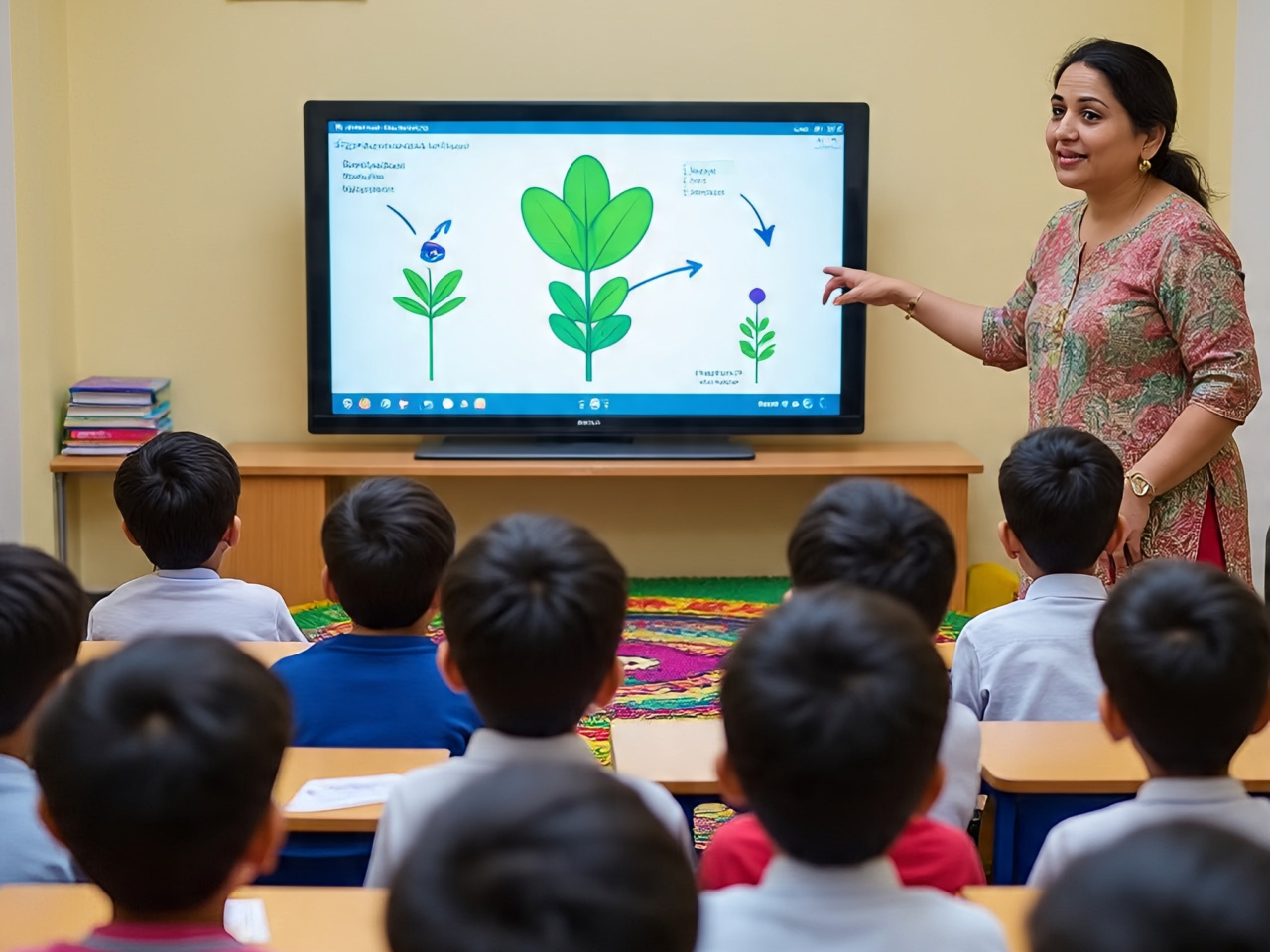
Smartboards are large touch-sensitive screens that work like computers. Teachers can use them to show videos, presentations, animations, and even draw diagrams using a digital pen or finger. These boards come with built-in educational content for different subjects and classes.
This shift gave birth to a new way of learning, digital content-based education.
3. Benefits of Smartboards and Digital Content in Classrooms
The use of smartboards and digital content brings several advantages:
a) Interactive and Fun Learning
Smartboards make lessons more interactive. Teachers can show animations, quizzes, maps, 3D images, and more. Students enjoy these lessons because they are fun, colourful, and easy to understand.
b) Improved Understanding of Concepts
Visuals help students understand difficult topics easily. For example, in science, students can see the working of the human heart, the solar system, or chemical reactions in real-time animations. In maths, teachers can show step-by-step problem solving in a clear and structured way.
c) Equal Learning for All Students
Digital content ensures that all students, whether from cities or villages, can learn the same concepts in the same way. Many smartboard providers offer content in both English and regional languages, which helps students from different backgrounds.
d) Time-Saving and Efficient
Teachers save time by using ready-made digital content. They can plan lessons better and cover the syllabus on time. With just a few clicks, they can revise old topics, conduct assessments, and give instant feedback.
e) Supports All Types of Learners
Every student learns differently. Some are visual learners, some are auditory, and some are kinesthetic. Smartboards cater to all types of learners by combining videos, sounds, touch interaction, and diagrams in one lesson.
4. The Role of EdTech Companies in India
Several Indian EdTech companies are driving the digital revolution in schools. Companies like Studynlearn, Byju’s, Teachmint, Next Education, and others are providing smartboards and K-12 digital content to thousands of schools across India.
Studynlearn, for example, offers interactive flat panels with built-in digital content from KG to Class 12. They also provide a 3-year on-site warranty and free maintenance, which is very helpful for schools in small towns. Their content is mapped to CBSE and state boards, making it easy for teachers to follow the curriculum.
These companies are helping schools modernize classrooms without spending too much money.
5. How Teachers Are Adapting to the Change
Initially, many teachers found it difficult to use smartboards and digital content. But with proper training and support, teachers are now enjoying the benefits of digital teaching.
In fact, many teachers say that students are more attentive in class and ask more questions. They also say that it has made their teaching job easier and more enjoyable.
Schools now organize regular training sessions to help teachers become comfortable with using digital tools. These trainings focus on:
- How to operate smartboards
- How to use subject-wise digital content
- How to assess students using smartboard tools
- How to record and share lessons online
6. Impact on Students in Indian Classrooms
Students are the biggest winners of this digital revolution. They no longer sit quietly and memorize everything. Now they:
- Participate in activities and discussions
- Learn through visuals, games, and simulations
- Use tablets and smart devices for self-learning
- Prepare for exams using videos and practice tests
Many students from rural areas have shown great improvement in learning because of digital content. It builds their confidence and helps them compete with students from bigger cities.
7. Smartboards During the COVID-19 Pandemic
The COVID-19 pandemic showed the real value of digital content. When schools shut down, teachers used smartboards to record video lessons and share them online. Schools that had digital setups managed to continue teaching without any major break.
The pandemic pushed many schools to adopt digital tools faster. Even government schools started using digital classrooms under various schemes.
8. Challenges in Reaching Every Classroom
Even though digital classrooms are growing, some challenges still exist:
- Many schools in remote areas don’t have electricity or internet.
- Some schools can’t afford smartboards or projectors.
- Teachers in rural areas need more training.
- Maintenance of digital equipment is a concern for many schools.
However, the Indian government and several private players are working together to solve these problems through CSR initiatives, public-private partnerships, and special funding programs.
9. Government Support for Digital Classrooms
The Indian government is promoting digital education through various programs:
- Digital India Campaign
- Samagra Shiksha Abhiyan
- PM eVIDYA and DIKSHA platforms
- Smart Class Projects in Kendriya Vidyalayas and State Schools
These programs provide digital infrastructure, teacher training, and free digital content to schools across India.
10. The Future: Smarter, Greener, and More Inclusive Classrooms
In the coming years, we will see more Indian classrooms using Artificial Intelligence, Augmented Reality (AR), and Virtual Reality (VR) to make learning even more powerful.
Smartboards will become smarter—with voice recognition, cloud-based lesson sharing, and real-time analytics to track student performance.
Digital content will be available in all Indian languages to reach every student. Schools will move towards paperless teaching, saving trees and making classrooms more eco-friendly.
With continued support from the government, educators, parents, and EdTech companies, we can build a future where every child in India has access to high-quality digital education.
Conclusion
The journey from chalkboards to smartboards marks a big shift in Indian education. This digital content revolution has changed the way teachers teach and students learn. Smartboards, interactive content, and trained teachers are creating classrooms that are engaging, effective, and future-ready.
While challenges still exist, the benefits of this transformation are clear. With continued efforts, India can make digital education accessible to every child, from the metros to the remotest villages.
The classroom of tomorrow is already here, and it’s smart, digital, and full of possibilities.
How Smartschool Education transformed teaching in schools?
Here is a snippet of how Smartschool Education’s Studynlearn Interactive flat panels have changed the teaching methodology of teachers.

"This is a digital board by the studynlearn, and I, Prakash Singh, at SP Genius Public School, have been using this smart board since last year. The students are feeling very comfortable, and we are explaining the topics in a very inclusive manner, whether it is science subjects, computer, or any environmental subjects, or whether it is SST or general awareness subjects, the students and the teacher both are enjoying the method of teaching. The students are also capable of understanding things in a very lucid and in a very fast manner, and teachers are using this smartboard to comprehend things in a very lucid manner. Thank you."
- Prakash Singh, SP Genius Public School
SmartSchool Education is a prominent EdTech company providing a wide range of educational solutions, including interactive flat panels, all-in-one PCs, a learning app, studio setup services, K-12 digital content, and school books under the Studynlearn and SNL brands.
To Know More, Call or Whatsapp on: 89270-89270
Related post:
- Reimagining Lesson Plans: Creative Ways Teachers Use Digital Content in Classrooms
- Digital Content for Holistic Learning: Blending Academics with 21st-Century Skills
- Beyond Textbooks: How Digital Content Makes Learning More Dynamic and Real
- Smart Learning Starts Here: Exploring the Impact of Digital Content in Schools
- Best Practices for Implementing Digital Content Learning in Schools
- How Digital Content Enhances Student Engagement and Academic Performance
- The Future of Education: Why Digital Content is Key to School Success
- Empowering Teachers: The Role of Digital Content in Modern Classrooms
- Transforming Traditional Classrooms with Interactive Digital Content
- Digital Content in Schools: Bridging the Gap Between Theory and Practice