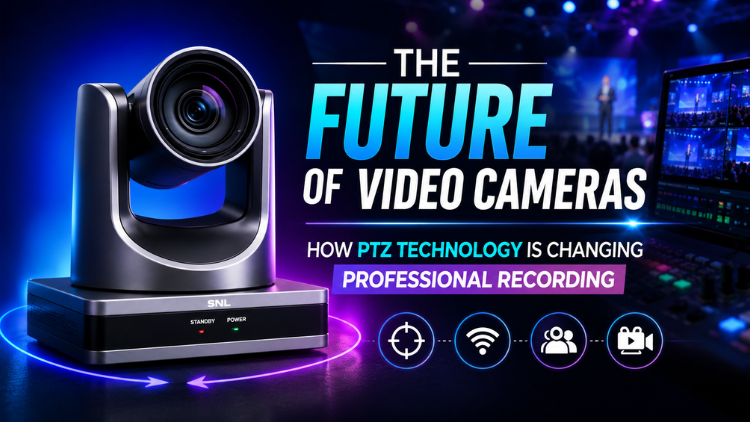
The Future of Video Cameras: How PTZ Technology Is Changing Professional Recording
The Evolution of Professional Video Cameras

What Is a PTZ Camera?

Why PTZ Technology Is Transforming Professional Recording
Reason 1: Intelligent AI Tracking and Auto Framing

- A teacher walking across a smart classroom remains perfectly centered.
- A keynote speaker at a conference stays in focus throughout the presentation.
- A content creator recording tutorials enjoys professional framing without an additional crew.
Reason 2: Professional Quality 4K Video Output

- Online education
- Corporate presentations
- Broadcast television
- Live streaming
- Product demonstrations
- Hybrid meetings
Reason 3: Flexible Remote Pan, Tilt, and Zoom Control

- Switch between preset camera positions
- Zoom into speakers
- Capture audience reactions
- Cover wide conference rooms
- Record panel discussions from multiple perspectives
Reason 4: Versatility Across Multiple Industries

Education
Corporate Communication
Broadcasting and Studios
Healthcare
Sports and Live Events
Reason 5: Cost-Effective Alternative to Multi-Camera Setups

- Lower equipment costs
- Reduced installation complexity
- Fewer camera operators
- Simplified maintenance
- Faster event setup
- Better return on investment
| Features | PTZ Camera | Traditional Video Camera |
| Camera Movement | Remote, Pan, Tilt & Zoom | Mostly Manual |
| AI Tracking | Yes | Usually Unavailable |
| Remote Operation | Yes | Limited |
| Installation | Permanent Ceiling Mounted | Portable |
| Operator Requirement | Minimal | Usually Required |
| Multi Angle Recording | Preset Positions | Manual Repositioning |
| Live Streaming | Excellent | Depends on Setup |
| Cost Efficiency | High Over Time | Higher Staffing Costs |
Key Features to Look for in a Professional PTZ Camera

- 4K Ultra HD resolution
- High optical zoom capability
- AI subject tracking
- Auto framing technology
- Fast and quiet pan-tilt motors
- HDMI, USB connectivity
- Low-light image performance
- Multiple preset camera positions
Selecting these features ensures the system remains useful for future production requirements.
Read More: 7 Key Features to Look for When Choosing a 4K PTZ Camera
Future Trends in PTZ Camera Technology

More Advanced AI
Cloud-Based Camera Management
Smarter Video Analytics
Higher Image Quality
Greater Integration
Introducing SNL PTZ Camera

SNL PTZ cameras are designed for educators and creators, ensuring broadcast-quality recording, seamless live sessions, and smooth tracking. Experience professional-quality video with 4K UHD clarity.
Key benefits include:
- Ultra-clear 4K camera video output.
- AI auto framing.
- Gesture control.
- AI-based tracking.
- Smooth pan and tilt movement.
- Preset camera angles for lectures or meetings.
- Perfect for classrooms, webinars, and studio recordings.
Conclusion
Frequently Asked Questions (FAQs)
A ptz camera (Pan-Tilt-Zoom camera) is a professional video camera that can move horizontally, vertically, and zoom in or out through remote control. Unlike a fixed camera, it allows operators to change viewing angles without physically touching the device. Modern PTZ cameras also include AI-powered tracking, auto framing, and preset positions, making them ideal for classrooms, conference rooms, studios, live events, and corporate meetings. Their flexibility and automation help organizations produce professional-quality videos with less equipment and fewer operators.
A ptz camera differs from a traditional video camera because it offers remote pan, tilt, and zoom control, while most conventional cameras require manual operation. PTZ cameras also support AI tracking, automatic framing, and programmable camera presets, allowing a single operator to manage multiple views efficiently. Traditional cameras are better suited for handheld shooting and mobile filmmaking, whereas PTZ systems excel in fixed installations such as classrooms, studios, auditoriums, conference halls, houses of worship, and live streaming environments.
The popularity of the ptz camera comes from its ability to deliver professional recording with minimal manpower. Organizations can remotely operate the camera, automate subject tracking, and capture multiple angles using one device. This reduces production costs while improving efficiency. Businesses, educators, broadcasters, and event organizers appreciate PTZ technology because it supports hybrid communication, online learning, webinars, and live streaming without requiring a dedicated camera operator for every recording session.
A ptz camera provides several advantages, including AI-powered subject tracking, remote operation, professional 4K video quality, optical zoom, and flexible camera positioning. It simplifies video production by reducing manual adjustments and allowing users to create multiple camera angles from one installation. Compared to a traditional video camera setup, PTZ systems require fewer operators, lower maintenance, and less equipment, making them a practical choice for organizations seeking high-quality, cost-effective professional recording solutions.
Many industries rely on ptz camera technology for professional communication and content production. Educational institutions use them for hybrid learning and lecture recording. Businesses depend on them for webinars, meetings, and executive presentations. Broadcasters use PTZ cameras for studio production and live news coverage. Event organizers capture conferences and performances, while healthcare organizations use them for medical training and remote consultations. Houses of worship, sports venues, and content creators also benefit from their flexibility, automation, and consistent video quality.
Yes. A ptz camera is often a worthwhile investment because it combines several production capabilities into one system. Instead of purchasing multiple video camera units and hiring additional operators, organizations can remotely manage recordings with fewer resources. Over time, this reduces equipment costs, staffing expenses, and operational complexity. Businesses, schools, broadcasters, and content creators also benefit from improved workflow, consistent recording quality, and easier live streaming, making PTZ technology a strong long-term investment.
In many professional environments, a ptz camera can replace several traditional video camera units. Its ability to pan, tilt, zoom, and switch between preset positions allows it to cover different areas from a single location. While very large productions may still require multiple cameras, PTZ technology significantly reduces the number of devices and operators needed for classrooms, boardrooms, conference halls, churches, webinars, and corporate events, helping organizations lower production costs without sacrificing quality.
When choosing a professional ptz camera, prioritize features such as 4K Ultra HD resolution, high optical zoom, AI tracking, auto framing, quiet pan-tilt motors, low-light performance, and multiple connectivity options like HDMI, USB, SDI, and IP streaming. Support for NDI, remote management, and preset camera positions also improves usability. Selecting these features ensures the camera delivers reliable performance across education, broadcasting, corporate communication, live events, and professional content creation.
Yes. A ptz camera works exceptionally well in classrooms, training centers, conference rooms, and corporate meeting spaces. AI tracking follows presenters naturally, while auto framing keeps them centered during lectures or presentations. Remote control enables operators to adjust camera angles without interrupting the session. Combined with high-quality audio and 4K video, PTZ systems improve hybrid learning, video conferencing, employee training, and webinar production, providing a better experience for both in-person and remote participants.
The future of ptz camera technology focuses on smarter automation, improved AI capabilities, and seamless integration with professional workflows. Future systems will offer more accurate subject tracking, intelligent scene recognition, cloud-based camera management, advanced video analytics, and even better image quality. As hybrid education, remote work, live streaming, and digital communication continue to grow, PTZ cameras will play an increasingly important role in professional video camera systems, helping organizations create high-quality content more efficiently than ever before.