How to Choose the Best Smart Board for Classroom
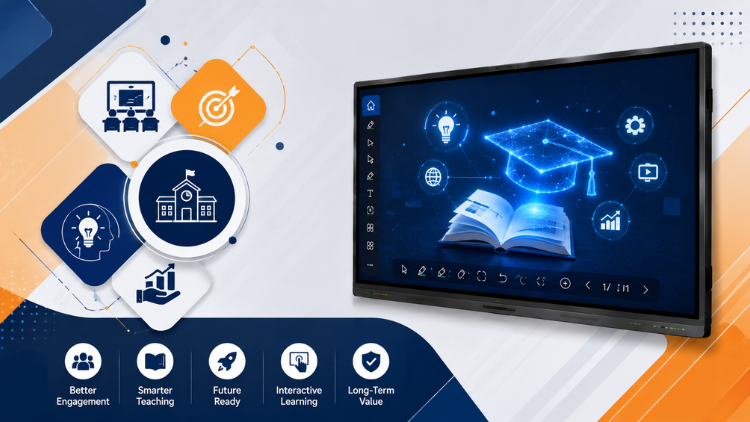
What Is a Smart Board for Classroom?

Why Digital Board for Teaching Price Should Not Be the Only Decision Factor

- Several factors influence the overall investment:
- Screen size suitable for classroom capacity
- 4K display resolution for better visibility
- Multi-touch capability for collaborative learning
- Operating system performance
- RAM and internal storage
- Interactive teaching software
- Connectivity options such as HDMI, USB, Wi-Fi, and Bluetooth
- Built-in speakers and microphones
- Professional installation
- Warranty coverage
- Reliable after-sales service
Essential Features to Compare Before Buying

Display Quality
Interactive Touch Technology
- Multi-touch support for simultaneous student participation
- Smooth handwriting recognition
- Low touch response time
- Accurate annotation tools
Operating System and Performance
Connectivity
Audio and Video Features
Eye-Care Technology
Security and Software Support
- Secure user access
- Regular firmware updates
- Software compatibility
- Reliable technical assistance
Smart Board for Classroom vs Traditional Whiteboard

| Features | Smartboard for Classroom | Traditional Whiteboard |
| Classroom interaction | Highly interactive | Limited |
| Student engagement | Multimedia-rich learning | Primarily text-based |
| Multimedia support | Videos, animations, presentations | Not available |
| Lesson preparation | Digital and reusable | Manual every session |
| Collaboration | Multi-user touch support | One user at a time |
| Assessment | Interactive quizzes and annotations | Manual evaluation |
| Resource sharing | Cloud and digital sharing | Physical notes only |
| Long-term value | Supports future-ready classrooms | Limited digital capabilities |
How to Evaluate the Right Interactive Flat Panel for Your School

- Understand classroom size and usage. Choose a screen size that ensures clear visibility for every student.
- Compare features before comparing cost. Hardware quality, software, and usability should guide the decision.
- Check software compatibility. Ensure the panel works with existing educational platforms and digital learning solutions.
- Evaluate warranty and long-term support. Reliable after-sales service reduces downtime and maintenance concerns.
- Plan teacher training. Even the best classroom technology delivers maximum value only when educators are confident using it.
- Choose a scalable solution. Select technology that can support future expansion across multiple classrooms or campuses.
Common Mistakes Schools Should Avoid

Buying Only Based on Price
Ignoring After-Sales Support
Choosing the Wrong Screen Size
Overlooking Software Updates
Neglecting Teacher Training
Ignoring Future Growth
Future of Interactive Classroom Technology

- AI-assisted lesson planning
- Cloud-based teaching resources
- Real-time student performance analytics
- Personalized learning experiences
- Interactive assessments
- Hybrid learning environments
- Seamless classroom collaboration across devices
Conclusion
Frequently Asked Questions (FAQs)
Choosing the best smart board for classroom starts with understanding your educational needs rather than focusing only on specifications. Consider classroom size, display resolution, touch responsiveness, software compatibility, connectivity options, built-in operating system, and after-sales support. Schools should also compare warranty coverage and long-term maintenance. While evaluating different options, it's important to consider the digital board for teaching price alongside the overall value it delivers. A reliable interactive display improves student engagement, supports multimedia lessons, and provides long-term benefits that extend well beyond the initial investment.
The digital board for teaching price varies depending on factors such as screen size, display quality, multi-touch capability, built-in software, operating system, RAM, storage, connectivity features, and warranty. Premium models may also include AI-powered tools, cloud integration, and enhanced collaboration features. Installation services and technical support can also affect the overall cost. Instead of selecting the lowest-priced option, schools should compare the complete feature set and long-term reliability. Investing in a quality interactive display often provides better educational outcomes and reduces future maintenance expenses.
A smart board for classroom offers significantly more functionality than a traditional whiteboard. Teachers can present multimedia lessons, annotate documents, access online educational resources, conduct interactive quizzes, and encourage student participation directly on the screen. Unlike conventional boards, interactive displays allow lessons to be saved, shared, and reused. They also support hybrid learning and collaborative activities. These capabilities make teaching more engaging and efficient while helping students understand concepts through visual and interactive learning. As education becomes increasingly digital, smart boards have become essential tools for modern classrooms.
Not necessarily. A higher digital board for teaching price often reflects additional features such as larger screen sizes, better display resolution, enhanced touch technology, premium software, or extended warranty coverage. However, schools should purchase based on their specific classroom requirements rather than choosing the most expensive option. Comparing usability, educational software compatibility, technical support, and long-term reliability is more important than comparing prices alone. A well-balanced solution that meets teaching needs often delivers greater value than an expensive model with features that may never be used.
Schools should evaluate display resolution, touch accuracy, multi-user support, operating system, processing performance, wireless screen sharing, annotation tools, cloud integration, built-in speakers, security features, and compatibility with laptops and tablets. Eye-care technology and regular software updates are also important for long-term usability. Along with comparing the digital board for teaching price, institutions should assess warranty coverage and after-sales support. Selecting a smart board with the right combination of features ensures better classroom performance, improved teacher productivity, and a future-ready learning environment.
Yes. Modern interactive displays are designed to support both in-person and hybrid learning. Teachers can conduct live online classes, share digital content, annotate lessons in real time, record sessions, and integrate with video conferencing platforms. Students can access learning materials even when attending remotely, ensuring continuity in education. Schools evaluating the digital board for teaching price should consider these hybrid learning capabilities because they provide long-term flexibility and help institutions adapt to changing educational requirements without investing in separate teaching systems.
A smart board for classroom encourages active participation by allowing students to interact directly with lesson content. Teachers can use videos, animations, diagrams, simulations, quizzes, and collaborative activities to make learning more engaging. Interactive lessons cater to different learning styles, helping students retain information more effectively. The ability to involve learners in discussions and problem-solving activities also improves collaboration and critical thinking. These educational benefits often justify the investment, making interactive classroom technology a valuable addition to modern schools.
A quality smart board for classroom can provide reliable performance for many years when maintained properly. Its lifespan depends on factors such as hardware quality, frequency of use, software updates, and regular maintenance. Choosing a solution with a comprehensive warranty and dependable technical support helps maximize its value. Schools should view the digital board for teaching price as a long-term investment rather than a one-time purchase. Proper care, routine software updates, and responsible usage ensure consistent classroom performance throughout the product's lifecycle.
Schools should compare more than the purchase cost. Evaluate display technology, touch performance, software features, connectivity, installation services, warranty, technical support, and long-term maintenance. Requesting product demonstrations and reviewing educational use cases can also help identify the best solution. A lower digital board for teaching price may not always provide the best classroom experience if important features or support services are missing. Focusing on total value helps institutions make informed purchasing decisions that support teaching and learning for years to come.
For most schools, colleges, and coaching institutes, investing in a smart board for classroom is a strategic decision that supports digital transformation in education. Interactive displays improve lesson delivery, increase student engagement, simplify collaboration, and provide access to a wide range of digital learning resources. While the digital board for teaching price is an important consideration, the long-term advantages include reusable lesson materials, enhanced teacher productivity, reduced dependence on printed resources, and better preparation for hybrid learning. These benefits make interactive classroom technology a valuable investment in future-ready education.