How an Interactive Flat Panel Improves Learning Outcomes
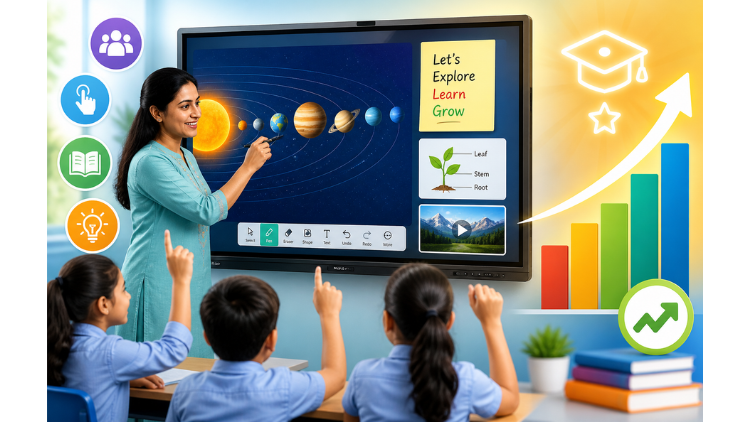
What is an Interactive Flat Panel?

1. Makes Learning More Engaging

2. Improves Concept Clarity

- Math teachers can solve problems step-by-step on the screen.
- Science teachers can show experiments through animations.
- Geography teachers can display maps and real-time visuals.
3. Encourages Active Participation

- Conduct live quizzes
- Invite students to solve problems on the board
- Use polls and instant feedback tools
4. Supports Different Learning Styles

- Visual learners benefit from images and videos
- Auditory learners benefit from audio explanations
- Kinesthetic learners benefit from touch and interaction
5. Saves Time for Teachers

- Access ready-made digital content
- Save and reuse lesson plans
- Quickly switch between topics
6. Enables Real-Time Assessment

- Conduct instant quizzes
- Analyze student responses immediately
- Identify weak areas on the spot
7. Makes Learning Fun and Interactive

- Educational games
- Interactive quizzes
- Visual storytelling
8. Encourages Collaboration

- Assign group activities
- Let students solve problems together on the screen
- Encourage discussions and presentations
9. Provides Access to Digital Content

- Online resources
- Educational videos
- Digital libraries
- Interactive lessons
10. Prepares Students for the Future

- Digital communication
- Problem-solving using technology
- Online learning environments
Real Classroom Scenario

- Easy to understand
- Interesting to follow
- Easy to remember
Why Schools in India Should Adopt It

- Large class sizes
- Limited engagement
- Traditional teaching methods
- Making lessons more interactive
- Managing large classrooms effectively
- Improving overall learning quality
Conclusion
For More Information, Call or WhatsApp on: 89270-89270.
Frequently Asked Questions (FAQs)
An interactive flat panel in education is a digital display that allows teachers and students to interact directly with learning content. It combines features like touch functionality, multimedia support, and internet access in one device. Teachers can write, draw, show videos, and conduct quizzes on the same screen. This makes lessons more engaging and easy to understand. Unlike traditional boards, it offers better clarity and saves time. Many Indian schools now use this tool as part of smart classroom technology to improve teaching quality and student participation in daily lessons.
An interactive flat panel improves learning outcomes by making lessons more engaging and interactive. Students understand concepts faster when they see visuals, animations, and real-life examples. Teachers can explain complex topics clearly using diagrams and videos. It also allows instant quizzes and feedback, which helps students learn from their mistakes quickly. This tool supports different learning styles, so every student benefits. When schools use interactive flat panel in education along with smart classroom technology, they create a better learning environment that increases student focus, participation, and academic performance.
Smart classroom technology helps schools modernize teaching methods and improve student engagement. It allows teachers to use digital tools, multimedia content, and interactive lessons instead of relying only on textbooks. This makes learning more interesting and effective. Students stay more focused and understand topics better. It also helps teachers save time by using ready-made content and quick assessments. In Indian classrooms, where student attention can be a challenge, smart classroom technology plays a key role in improving learning outcomes and making education more practical and future-ready.
Yes, interactive flat panels can replace traditional blackboards in most classrooms. They offer more features, such as touch interaction, multimedia support, and internet access. Teachers can explain topics using videos, diagrams, and real-time examples, which is not possible with a blackboard. It also reduces chalk dust and maintenance efforts. However, schools may still keep traditional boards as backup options. Overall, interactive flat panel in education provides a more advanced and efficient teaching method compared to traditional tools, especially when combined with smart classroom technology.
Yes, interactive flat panels work well for all subjects. In mathematics, teachers can solve problems step-by-step. In science, they can show experiments and animations. In geography, they can display maps and real-time visuals. Even language teachers can use videos and storytelling tools to improve understanding. This flexibility makes interactive flat panel in education useful across different classes and subjects. When integrated with smart classroom technology, it helps teachers deliver better lessons and ensures students stay engaged regardless of the subject they are studying.
Yes, interactive flat panels help teachers save a lot of time. Teachers can use pre-loaded digital content, access online resources, and save lesson plans for future use. They do not need to write everything manually on the board. Switching between topics also becomes faster. This allows teachers to focus more on explaining concepts and interacting with students. In classrooms that use smart classroom technology, teachers can also conduct quick assessments and get instant results. Overall, interactive flat panel in education improves teaching efficiency and reduces workload.
Every student learns differently. Some prefer visuals, some prefer listening, and others learn by doing. Interactive flat panels support all these styles. Teachers can use videos for visual learners, audio explanations for auditory learners, and touch-based activities for kinesthetic learners. This ensures that every student understands the lesson in their own way. Interactive flat panel in education creates an inclusive learning environment where no student feels left out. When combined with smart classroom technology, it helps teachers deliver lessons that match the needs of diverse learners in Indian classrooms.
Yes, most interactive flat panels are user-friendly and easy to operate. Teachers can learn basic functions quickly with minimal training. The interface is simple, and many panels come with built-in tools for writing, drawing, and presenting content. Schools also provide training sessions to help teachers feel comfortable using the technology. Once teachers start using it regularly, they find it more convenient than traditional methods. Interactive flat panel in education simplifies teaching and helps educators use smart classroom technology effectively without technical difficulty.
Interactive flat panels make student assessment faster and more effective. Teachers can conduct quizzes, polls, and tests directly on the screen. Students can answer instantly, and results appear in real time. This helps teachers identify weak areas and adjust their teaching methods immediately. It also saves time compared to traditional paper-based tests. Interactive flat panel in education allows continuous assessment instead of waiting for exams. When used with smart classroom technology, it helps teachers track progress and improve learning outcomes in a structured way.
Yes, investing in interactive flat panels is worth it for schools that want to improve education quality. It enhances student engagement, improves understanding, and supports modern teaching methods. Teachers become more efficient, and students enjoy learning more. Over time, this leads to better academic results and overall development. In India, many schools already see positive outcomes after adopting interactive flat panel in education. When combined with smart classroom technology, it becomes a long-term investment that benefits both teachers and students while preparing them for a digital future.
Related post:
- Smart Board for Teaching: 5 Questions Every School Should Ask Before Buying
- Smart Board for Teaching Price? Everything Schools Should Know
- The Future of Smart Board in Indian Education
- Interactive Panel Myths Debunked: 5 Things Every School Should Know
- The Future of Smart Classrooms: Why Digital Board Is Becoming Essential
- Dept of Agricultural Research and Education, Uttarakhand Chooses SmartSchool Education for Advanced Digital Learning Solutions
- The Role of Interactive Panels in Creating Smart Classrooms
- The Future of Smart Classrooms with Interactive Flat Panels
- Interactive Flat Panel for Classroom - Complete Buyer Guide for Schools
- How Teachers Can Save Time Using an Interactive Flat Panel