The Future of Smart Classrooms: Why Digital Board Is Becoming Essential
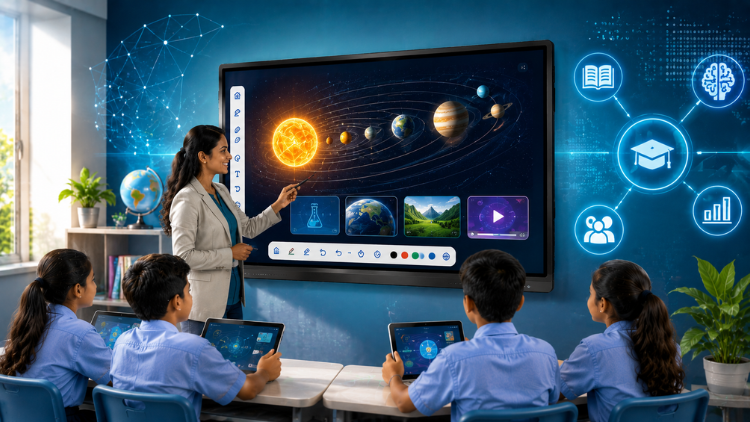
What Is a Smart Classroom?

- Interactive displays
- Artificial intelligence tools
- Educational software
- Cloud-based learning platforms
- Video conferencing solutions
- Digital assessment systems
- Collaborative learning applications
What Is a Digital Board?

The Evolution of Classroom Technology

Traditional Classroom Era
- Chalkboards
- Printed textbooks
- Manual assessments
- One-way teaching methods
Digital Transition Era
- Projectors
- Computers
- Multimedia presentations
- Educational software
Smart Classroom Era
- Interactive displays
- AI-powered learning tools
- Cloud-based content management
- Hybrid learning systems
- Real-time collaboration technologies
Why Digital Boards Are Becoming Essential in Modern Education

- Deliver interactive lessons
- Improve classroom participation
- Integrate multimedia content
- Support remote learning
- Use AI-powered educational tools
- Conduct digital assessments
- Personalize learning experiences
Benefit 1: Enhanced Student Engagement and Interactive Learning

- Students solve math problems directly on the screen.
- Science teachers demonstrate interactive simulations.
- Geography lessons use maps and visual animations.
- Language teachers conduct collaborative exercises.
- History lessons incorporate videos and digital timelines.
Benefit 2: Improved Teaching Efficiency and Content Delivery

- Access digital lesson plans instantly
- Annotate content in real time
- Save and reuse classroom materials
- Integrate videos and presentations
- Conduct instant assessments
- Share learning resources digitally
Benefit 3: Support for Hybrid, Online, and Future Learning Models

- In-person learning
- Hybrid education
- Remote instruction
- Blended learning environments
- Video conferencing integration
- Wireless screen sharing
- Cloud-based collaboration
- Digital content sharing
- Recording and playback capabilities
Benefit 4: AI Integration and Smart Educational Tools

- AI lesson planning
- Automated question generation
- Worksheet creation
- Smart assessment tools
- Handwriting recognition
- Content recommendations
- Learning analytics
Benefit 5: Long-Term Value and Future Readiness for Schools

Reduced operational costs
- Lower printing expenses
- Reduced paper usage
- Minimal maintenance requirements
- Long display lifespan
Increased educational value
- Better learning outcomes
- Improved teacher productivity
- Enhanced institutional reputation
- Greater student satisfaction
Challenges Schools Face Without Digital Boards

Reduced student engagement
Limited teaching flexibility
Difficulty supporting hybrid education
Reduced competitiveness
Limited AI adoption
The Future of Smart Classrooms in India and Globally

Artificial Intelligence
Extended Reality
Cloud-Based Learning Ecosystems
Data-Driven Education
Interactive Classroom Technologies
Conclusion
Frequently Asked Questions (FAQs)
A digital board is an interactive educational display that combines touchscreen technology, multimedia capabilities, internet connectivity, and educational software into a single classroom solution. Teachers can display presentations, annotate lessons, play videos, conduct quizzes, and collaborate with students in real time. Unlike traditional whiteboards or projectors, a smart board for teaching allows direct interaction through touch, stylus, and AI-powered tools. Schools use these systems to create engaging learning environments that improve classroom participation, support digital learning initiatives, and enhance the overall teaching and learning experience.
The digital board has become essential because education increasingly requires interactive, flexible, and technology-driven teaching methods. Modern classrooms need tools that support multimedia learning, student collaboration, online education, and personalized instruction. A smart board for teaching enables educators to combine videos, simulations, assessments, and interactive activities within a single lesson. Additionally, schools adopting smart classroom technologies often experience improved student engagement, better teaching efficiency, and stronger academic outcomes. As digital transformation accelerates globally, educational institutions view digital boards as a fundamental investment for future-ready learning environments.
A smart board for teaching improves learning outcomes by increasing student engagement, participation, and knowledge retention. Interactive lessons encourage students to actively participate rather than passively consume information. Teachers can use animations, simulations, educational games, and collaborative activities to explain complex concepts more effectively. A digital board also supports differentiated instruction, allowing educators to adapt lessons according to student learning needs. Research and classroom experience consistently show that interactive learning environments help students develop critical thinking skills, improve academic performance, and maintain higher levels of classroom attention.
Yes, a digital board is considered a worthwhile long-term investment for most schools. Beyond improving educational outcomes, digital boards reduce reliance on printed materials, simplify lesson preparation, and support hybrid learning models. A high-quality smart board for teaching typically offers several years of operational life with minimal maintenance costs. Schools also benefit from increased teacher productivity, enhanced institutional reputation, and improved student satisfaction. As educational technology becomes increasingly important, investing in digital classroom infrastructure helps schools remain competitive while preparing students for future academic and professional environments.
A digital board plays a critical role in supporting hybrid, blended, and online learning models. Teachers can conduct live virtual classes, share digital content, record lessons, and collaborate with remote students simultaneously. Modern smart board for teaching systems often integrate video conferencing platforms, cloud storage, screen sharing, and learning management systems. These features allow schools to maintain educational continuity during disruptions while expanding access to learning opportunities. Hybrid education models continue to grow worldwide, making digital boards an essential technology for flexible and accessible classroom instruction.
Artificial intelligence is rapidly transforming the capabilities of the modern digital board. AI-powered features can assist teachers with lesson planning, worksheet generation, question creation, handwriting recognition, content recommendations, and student assessment analysis. A next-generation smart board for teaching can help educators save time while delivering more personalized learning experiences. AI tools also provide insights into student performance and learning gaps, enabling targeted interventions. As artificial intelligence continues evolving, its integration with classroom technology will become one of the defining characteristics of future smart education systems.
Several emerging technologies will influence the future of smart classrooms, including artificial intelligence, cloud computing, augmented reality, virtual reality, learning analytics, and collaborative digital platforms. The digital board will remain the central interface connecting these technologies within the classroom environment. Future smart board for teaching solutions will likely include advanced AI assistants, immersive learning experiences, predictive analytics, and personalized educational pathways. Schools adopting these technologies early will be better positioned to provide innovative learning experiences and prepare students for increasingly digital careers and industries.
A digital board significantly improves teaching efficiency by allowing educators to manage lessons, assessments, multimedia content, and classroom collaboration from a single platform. Teachers can save lesson materials, reuse presentations, annotate documents in real time, and conduct instant assessments without switching between multiple devices. A smart board for teaching also reduces administrative workload by integrating digital learning resources and cloud-based tools. These capabilities allow teachers to focus more on student learning and less on classroom management, ultimately improving instructional quality and educational effectiveness.
Schools that do not adopt technologies such as the digital board often face challenges related to student engagement, teaching flexibility, and educational competitiveness. Traditional teaching methods may struggle to meet the expectations of digitally native students. Without a smart board for teaching, educators may have limited access to interactive content, hybrid learning capabilities, and AI-powered educational tools. Additionally, schools risk falling behind institutions that offer modern learning environments. As education becomes increasingly technology-driven, digital transformation is becoming a necessity rather than an option.
Before purchasing a digital board, schools should evaluate factors such as display quality, touch responsiveness, operating system, AI capabilities, educational software compatibility, warranty coverage, teacher training requirements, and long-term support services. Decision-makers should also assess whether the smart board for teaching integrates with existing classroom infrastructure and future educational goals. Choosing a scalable and future-ready solution ensures better return on investment and supports ongoing technological advancements. Schools that prioritize both educational outcomes and long-term value typically achieve the greatest success with smart classroom implementation.
Related post:
- 5 Things an Interactive Flat Panel with AI Can Help Teachers Do
- Can an Interactive Flat Panel with AI Become a Teacher’s Digital Assistant?
- 5 Everyday Teaching Tasks an AI Smart Board Could Make Simpler
- How to Select the Right Interactive Panel for Classroom Based on School Requirements
- Smart Board for Teaching: 5 Questions Every School Should Ask Before Buying
- Smart Board for Teaching Price? Everything Schools Should Know
- The Future of Smart Board in Indian Education
- Interactive Panel Myths Debunked: 5 Things Every School Should Know
- Dept of Agricultural Research and Education, Uttarakhand Chooses SmartSchool Education for Advanced Digital Learning Solutions
- The Role of Interactive Panels in Creating Smart Classrooms