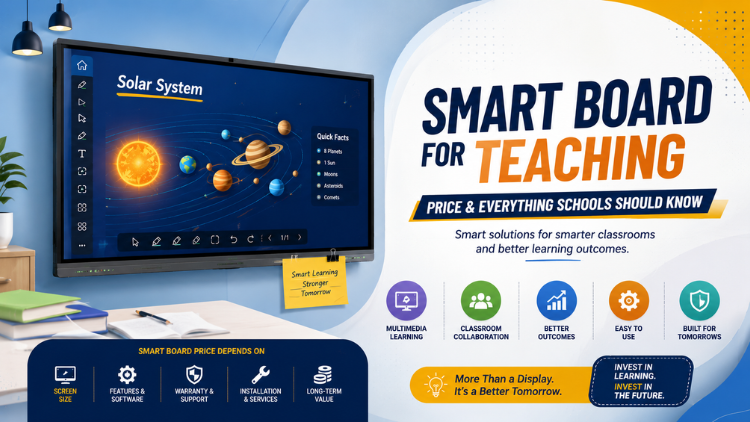
Smart Board for Teaching Price? Everything Schools Should Know
What Is a Digital Board for Teaching?

- Interactive touchscreen display
- Built-in Android operating system
- High-resolution display
- Multi-touch functionality
- Integrated speakers
- Wireless and wired connectivity
- Educational software support
What Factors Affect Smart Board for Teaching Price?

Screen Size
Display Resolution
Multi-Touch Technology
Built-in Android Operating System
RAM and Storage
Interactive Software
Audio Quality
Connectivity Options
Warranty and After-Sales Support
Installation Requirements
Why Schools Should Look Beyond the Initial Cost

- Lower maintenance compared to multiple traditional teaching tools.
- Improved teaching efficiency through reusable digital lesson materials.
- Better student engagement with multimedia teaching.
- Reduced dependence on printed worksheets and handouts.
- Easier classroom collaboration using interactive activities.
- Faster lesson preparation with saved teaching resources.
- Greater adaptability for hybrid learning and digital classrooms.
Essential Features to Compare Before Buying

- 4K UHD display for clear visuals
- Multi-touch support for collaborative learning
- HDMI, USB, Wi-Fi, and Bluetooth connectivity
- Annotation and digital whiteboard tools
- Cloud integration for lesson storage
- Eye-care technology for comfortable viewing
- Compatibility with educational software and content
- Easy content management and lesson organization
- Security features including user access controls and software updates
Digital Board for Teaching vs Traditional Teaching Tools
| Feature | Digital Board For Teaching | Traditional Whiteboard |
| Classroom interaction | Highly interactive | Limited |
| Student engagement | Multimedia-rich lessons | Mostly text-based |
| Multimedia support | Videos, animations, presentations | Not available |
| Lesson preparation | Digital and reusable | Manual every time |
| Collaboration | Multi-user interaction | Single-user writing |
| Assessment | Interactive quizzes and activities | Manual evaluation |
| Resource sharing | Cloud and digital sharing | Physical copies |
| Long-term value | Supports future-ready classrooms | Limited functionality |
Best Practices for Choosing the Right Digital Board

- Assess classroom size and teaching requirements.
- Compare features instead of only the purchase cost.
- Ensure compatibility with existing educational software.
- Evaluate warranty, maintenance, and after-sales support.
- Plan teacher training for effective adoption.
- Choose scalable solutions that can support future educational technology needs.
Future of Digital Boards in Indian Education

Conclusion
Frequently Asked Questions (FAQs)
The smart board for teaching price depends on several factors, including screen size, display resolution, touch technology, built-in operating system, RAM, storage, connectivity options, bundled software, warranty, and after-sales support. Installation requirements and additional accessories can also influence the final cost. Schools should evaluate the overall value rather than focusing only on the purchase price. A high-quality digital board for teaching with reliable performance, long-term software updates, and technical support often provides a better return on investment by improving classroom engagement, reducing maintenance needs, and supporting modern teaching methods for years to come.
A digital board for teaching enhances classroom learning by making lessons more interactive, engaging, and collaborative. Teachers can display multimedia content, annotate presentations, conduct quizzes, and access online educational resources in real time. Students benefit from visual learning, hands-on participation, and improved understanding of complex concepts. Digital boards also support hybrid learning, allowing lessons to be shared with remote students when required. Although schools often compare the smart board for teaching price, the long-term educational value, improved teaching efficiency, and future-ready learning environment make it a worthwhile investment.
A traditional whiteboard is designed only for writing with markers, whereas a digital board for teaching combines touchscreen technology, multimedia support, internet connectivity, and interactive educational tools. Teachers can display presentations, videos, websites, digital textbooks, and collaborative activities while saving lesson notes for future use. Students can participate directly by writing or interacting with the display. Unlike traditional boards, digital boards promote active learning, simplify lesson planning, and encourage classroom collaboration. This makes them an essential technology for schools aiming to improve learning outcomes and embrace modern education.
Not necessarily. A higher smart board for teaching price often reflects additional features, larger screen sizes, premium software, or advanced hardware, but schools should purchase according to their actual classroom needs. Before making a decision, compare display quality, touch responsiveness, compatibility with educational software, warranty coverage, ease of use, and technical support. A digital board for teaching that offers the right balance of performance, reliability, and classroom functionality usually delivers greater value than simply choosing the most expensive model. Focusing on long-term educational outcomes is more important than focusing on price alone.
Schools should compare screen resolution, display brightness, multi-touch capability, operating system, RAM, storage, wireless screen sharing, built-in speakers, annotation tools, cloud compatibility, and educational software support. Other important considerations include eye-care technology, security features, regular software updates, warranty duration, and after-sales service. While evaluating the smart board for teaching price, decision-makers should ensure the selected solution meets both current classroom requirements and future educational goals. Comparing these features carefully helps schools invest in a technology solution that supports effective teaching for many years.
Yes. A digital board for teaching is designed to support both in-person and hybrid education. Teachers can conduct live classes, share presentations, annotate documents, record lessons, and connect with students through video conferencing platforms. Many digital boards integrate with cloud storage and collaboration tools, making lesson materials easily accessible from different locations. Schools looking at the smart board for teaching price should also consider these hybrid learning capabilities because they increase flexibility, improve learning continuity, and help institutions adapt to evolving educational requirements without investing in separate systems.
A digital board for teaching transforms traditional lectures into interactive learning experiences. Teachers can use animations, videos, simulations, educational games, quizzes, and collaborative activities to capture students' attention. Touch-enabled interaction encourages learners to solve problems, participate in discussions, and engage directly with lesson content. Visual demonstrations make difficult concepts easier to understand, while multimedia resources support different learning styles. These benefits often justify the smart board for teaching price because increased engagement can improve student participation, knowledge retention, and overall classroom effectiveness.
The lifespan of a digital board for teaching depends on build quality, usage, maintenance, and software support. A well-maintained interactive display from a reputable manufacturer can provide reliable performance for many years while receiving regular firmware and software updates. Schools should also consider warranty coverage and technical support when evaluating the smart board for teaching price. Proper maintenance, including routine cleaning, software updates, and responsible usage, helps extend the device's lifespan and ensures consistent classroom performance throughout its operational life.
Schools should begin by identifying classroom size, teaching requirements, expected number of users, and preferred educational software. Next, compare multiple solutions based on display quality, interactive features, connectivity, warranty, and after-sales support rather than price alone. Reading product specifications carefully and requesting live demonstrations can help decision-makers evaluate usability. While comparing the smart board for teaching price, schools should also estimate long-term operational value, maintenance costs, and future scalability. This balanced approach helps institutions make informed purchasing decisions without compromising educational quality.
For most educational institutions, investing in classroom technology is a long-term strategy rather than a short-term expense. A digital board for teaching improves lesson delivery, student engagement, collaboration, and access to digital learning resources while supporting hybrid education and modern teaching practices. Although the smart board for teaching price may appear significant initially, the long-term benefits include reusable lesson materials, reduced dependence on printed resources, enhanced teacher productivity, and improved learning experiences. Schools that prioritize educational outcomes often find that the investment delivers lasting academic and operational value.
Related post:
- 5 Everyday Teaching Tasks an AI Smart Board Could Make Simpler
- How to Select the Right Interactive Panel for Classroom Based on School Requirements
- Smart Board for Teaching: 5 Questions Every School Should Ask Before Buying
- The Future of Smart Board in Indian Education
- Interactive Panel Myths Debunked: 5 Things Every School Should Know
- The Future of Smart Classrooms: Why Digital Board Is Becoming Essential
- Dept of Agricultural Research and Education, Uttarakhand Chooses SmartSchool Education for Advanced Digital Learning Solutions
- The Role of Interactive Panels in Creating Smart Classrooms
- The Future of Smart Classrooms with Interactive Flat Panels
- How an Interactive Flat Panel Improves Learning Outcomes