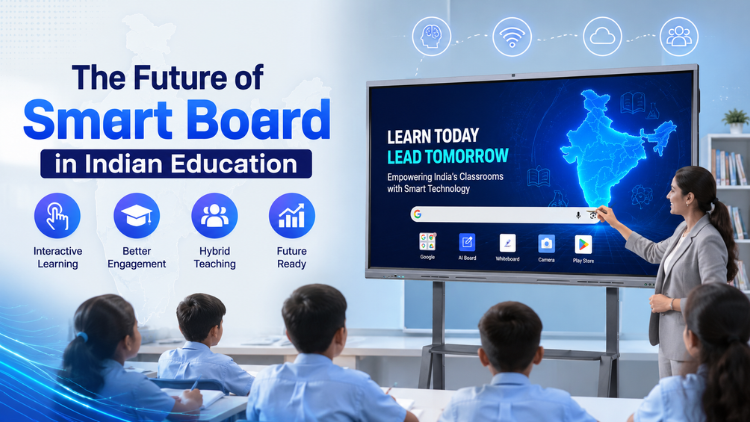
The Future of Smart Board in Indian Education
Why Indian Education Is Embracing Smart Technologies

How Smart Boards Are Transforming Modern Classrooms

What makes a smart board different?
Interactive teaching and visualization
Real-time collaboration
Internet-enabled learning
Traditional Classrooms vs. Technology-Enabled Classrooms

| Traditional Teaching | Smart Board-Enabled Teaching |
| Chalk & whiteboard instruction | Interactive multimedia lessons |
| Limited visual aids | Videos, animations, and simulations |
| Mostly one-way communication | Active student participation |
| Manual note-taking | Digital annotation and saved lessons |
| Printed resources | Easy access to online educational content |
| Less collaborative activities | Interactive group learning and classroom engagement |
Digital Boards and the Future of Teaching

AI-powered learning environments
Supporting hybrid education
Cloud-based teaching resources
Rich interactive content
Key Benefits Schools Can Expect in the Coming Years

- Improved learning outcomes through interactive teaching methods
- Higher classroom engagement with multimedia-based lessons
- Reduced dependence on traditional teaching materials
- Easy content sharing across classrooms and remote learners
- Greater cost efficiency over time through reusable digital resources
- Increased teacher productivity with simplified lesson management
- Faster access to digital educational content and cloud resources
- Development of future-ready classrooms that support evolving educational technology
Challenges Schools Should Consider

1. Initial investment
2. Teacher training
3. Infrastructure readiness
4. Internet connectivity
5. Device maintenance
The Future Outlook for Indian Schools

- Greater adoption of AI-assisted lesson planning and personalized learning.
- Wider implementation of Interactive Flat Panels across schools and higher education institutions.
- Enhanced digital collaboration between teachers, students, and parents.
- Expansion of smart classroom environments that support flexible learning.
- Increased use of cloud-based educational resources for seamless content access.
- Learning analytics that help teachers identify individual student needs.
- Adaptive learning platforms that adjust educational content according to student progress.
Key Takeaways

- A smart board combines interactive display technology with multimedia, internet access, and collaborative learning tools.
- A digital board supports hybrid teaching, cloud integration, and engaging classroom experiences.
- NEP 2020 encourages technology-enabled education that promotes critical thinking and student participation.
- Modern classroom technology enhances teaching without replacing educators.
- Successful implementation requires investment, teacher training, reliable infrastructure, and ongoing maintenance.
Conclusion
For More Information, call or WhatsApp on: 89270-89270.
Frequently Asked Questions (FAQs)
A smart board is an interactive digital display that combines touch technology, multimedia tools, and internet connectivity to make classroom teaching more engaging. Teachers can write digitally, display presentations, annotate documents, play educational videos, and access online resources from a single screen. Students can also interact directly with the display, encouraging collaborative learning and active participation. Unlike traditional whiteboards, a smart board allows lessons to be saved, shared, and reused, making teaching more efficient while supporting modern classroom practices and digital learning.
Indian schools are adopting smart boards to create more interactive and engaging learning environments. The growing emphasis on digital learning, hybrid education, and the goals of NEP 2020 has encouraged schools to integrate classroom technology into daily teaching. Smart boards help teachers explain concepts through visuals, videos, and interactive activities while improving student participation. They also simplify lesson planning, enable collaboration, and provide access to a wide range of digital educational resources that support modern teaching methods.
A digital board increases student engagement by making lessons more interactive and visually appealing. Instead of relying only on textbooks or lectures, teachers can use animations, videos, diagrams, quizzes, and collaborative exercises to explain concepts. Students can solve problems directly on the screen, participate in group activities, and receive immediate feedback. This interactive approach encourages curiosity, improves concentration, and supports different learning styles, resulting in a more active and enjoyable classroom experience.
Yes. Smart boards are suitable for schools, colleges, coaching centres, training institutes, and higher education institutions. Their flexibility allows educators to teach a wide range of subjects, from science and mathematics to languages and social sciences. Institutions can also use them for presentations, workshops, teacher training, and administrative meetings. Because they support interactive learning and digital content, smart boards can benefit learners of different age groups and educational levels.
NEP 2020 encourages the use of educational technology to improve teaching quality, student participation, and skill development. Smart boards support these objectives by enabling interactive teaching, collaborative learning, multimedia instruction, and digital resource integration. Teachers can create more engaging lessons while encouraging critical thinking, creativity, and problem-solving. They also support hybrid learning models and digital classrooms, helping institutions align with the broader vision of technology-enabled education outlined in the policy.
Schools should evaluate display size, touch responsiveness, screen resolution, software compatibility, annotation tools, operating system, cloud connectivity, wireless screen sharing, and after-sales support. They should also consider ease of use for teachers, compatibility with existing classroom technology, and long-term maintenance requirements. Selecting a solution that integrates well with interactive flat panels, digital learning platforms, and classroom management software can improve the overall teaching experience and maximize long-term value.
Yes. Smart boards are designed to support hybrid and blended learning environments. Teachers can conduct live classes, annotate lessons in real time, share digital content, and collaborate with students both inside and outside the classroom. Many systems integrate with video conferencing platforms and cloud storage, making it easier to deliver lessons to remote learners. This flexibility helps educational institutions maintain continuity while supporting both classroom-based and online education.
Schools should consider factors such as initial investment, teacher training, reliable internet connectivity, infrastructure readiness, and ongoing maintenance. While classroom technology offers significant long-term benefits, successful implementation requires careful planning and staff development. Providing teachers with regular training ensures they can effectively use digital tools and create engaging learning experiences. Institutions should also establish maintenance plans to keep equipment functioning efficiently over time.
The future of smart boards in India is closely linked to advancements in AI, cloud-based learning, interactive flat panels, and adaptive educational technology. As classrooms become increasingly digital, smart boards will serve as central teaching hubs that combine multimedia content, collaboration tools, analytics, and personalized learning resources. Along with supportive government initiatives and growing EdTech adoption, these technologies are expected to play a major role in building future-ready classrooms across schools, colleges, and training institutions.
Related post:
- 5 Everyday Teaching Tasks an AI Smart Board Could Make Simpler
- How to Select the Right Interactive Panel for Classroom Based on School Requirements
- Smart Board for Teaching: 5 Questions Every School Should Ask Before Buying
- Smart Board for Teaching Price? Everything Schools Should Know
- Interactive Panel Myths Debunked: 5 Things Every School Should Know
- The Future of Smart Classrooms: Why Digital Board Is Becoming Essential
- Dept of Agricultural Research and Education, Uttarakhand Chooses SmartSchool Education for Advanced Digital Learning Solutions
- The Role of Interactive Panels in Creating Smart Classrooms
- The Future of Smart Classrooms with Interactive Flat Panels
- How an Interactive Flat Panel Improves Learning Outcomes